Thursday, February 08, 2007

Emerson - Divinity School Address

Emerson explains why nonviolence works the way described by Dr. and Mrs. King, even though Emerson was not addressing the exquisite power of nonviolent action in the manner developed in the 20th Century:

From: Emerson - Divinity School Address


"The intuition of the moral sentiment is an insight of the perfection of the laws of the soul. These laws execute themselves. They are out of time, out of space, and not subject to circumstance. Thus; in the soul of man there is a justice whose retributions are instant and entire. He who does a good deed, is instantly ennobled. He who does a mean deed, is by the action itself contracted. He who puts off impurity, thereby puts on purity. If a man is at heart just, then in so far is he God; the safety of God, the immortality of God, the majesty of God do enter into that man with justice. If a man dissemble, deceive, he deceives himself, and goes out of acquaintance with his own being. A man in the view of absolute goodness, adores, with total humility. Every step so downward, is a step upward. The man who renounces himself, comes to himself.

See how this rapid intrinsic energy worketh everywhere, righting wrongs, correcting appearances, and bringing up facts to a harmony with thoughts. Its operation in life, though slow to the senses, is, at last, as sure as in the soul. By it, a man is made the Providence to himself, dispensing good to his goodness, and evil to his sin. Character is always known. Thefts never enrich; alms never impoverish; murder will speak out of stone walls. The least admixture of a lie, -- for example, the taint of vanity, the least attempt to make a good impression, a favorable appearance, -- will instantly vitiate the effect. But speak the truth, and all nature and all spirits help you with unexpected furtherance. Speak the truth, and all things alive or brute are vouchers, and the very roots of the grass underground there, do seem to stir and move to bear you witness. See again the perfection of the Law as it applies itself to the affections, and becomes the law of society. As we are, so we associate. The good, by affinity, seek the good; the vile, by affinity, the vile. Thus of their own volition, souls proceed into heaven, into hell.

These facts have always suggested to man the sublime creed, that the world is not the product of manifold power, but of one will, of one mind; and that one mind is everywhere active, in each ray of the star, in each wavelet of the pool; and whatever opposes that will, is everywhere balked and baffled, because things are made so, and not otherwise. Good is positive. Evil is merely privative, not absolute: it is like cold, which is the privation of heat. All evil is so much death or nonentity. Benevolence is absolute and real. So much benevolence as a man hath, so much life hath he. For all things proceed out of this same spirit, which is differently named love, justice, temperance, in its different applications, just as the ocean receives different names on the several shores which it washes. All things proceed out of the same spirit, and all things conspire with it. Whilst a man seeks good ends, he is strong by the whole strength of nature. In so far as he roves from these ends, he bereaves himself of power, of auxiliaries; his being shrinks out of all remote channels, he becomes less and less, a mote, a point, until absolute badness is absolute death."

Complete surrender works


For those who don't like to plow through 19th Century Emerson to get the gist of the Law he lovingly describes, here is a handy cartoon clip that explains the same principle. Complete surrender works the first time, every time. Indeed, it's the only thing that works.

Easy to say, hard to do.

What does this clip have to do with that idea? Watching it a few times will answer the question.

Even for those who eventually settle upon this answer, the presumption often is that the winning strategy of complete surrender only applies to inner torments, such as fear, depression, addiction, compulsion, and the unfathomable demons of the mind. Does the strategy of surrender apply to external events, such as conflicts in the workplace and home, or more dramatically, nations and war?

Jesus, Gandhi, Buddha, and Martin Luther King Jr. demonstrated the power of peace. So did Mohamed, who pardoned his enemies when he took Mecca. Did these great souls intend we should drop the internal knives we use to hurt ourselves and others, but cling to the tangible weapons of defense and offense?

Are there different love and fear rules for inside and outside? Is there an inside that is not the outside?

Monday, January 29, 2007

The secret of secrets

If you could get rid
Of yourself just once,
The secret of secrets
Would open to you.
The face of the unknown,
Hidden beyond the universe
Would appear on the
Mirror of your perception.

- Rumi

http://www.nuradeen.com/ASK/ASKConferences/ASKConference2004/IslamOfTheMind.htm

Wednesday, April 27, 2005

From the page: "Curious. Jesus updated the Ten Commandments in his most famous speech, the Sermon on the Mount. In it, one finds the Eight Beatitudes. Why don't we ever hear about nailing those somewhere? Here's why: It's not simply the law in the Ten Commandments that attracts fundamentalists. Rather, it's the syntax. The authoritarianism of so many "Thou Shalt Nots."

The syntax of Jesus' Eight Beatitudes is not so easy (Blessed are the poor in spirit. Blessed are the peacemakers). These words invite the kind of hard questions that Jesus loved to tweak his followers with. How are they blessed? And why? It's just like Jesus to leave us with questions instead of answers."

Here is a link to my favorite book about the Sermon on the Mount

Fox explains in his book: "The Truth turns out to be nothing less than the amazing but undeniable fact that the whole outer world--whether it be the physical body, the common things of life, the winds and the rain, the clouds, the earth itself--is amenable to man's thought, and that he has dominion over it when he knows it."

Easy to say, hard to do.

Friday, March 04, 2005


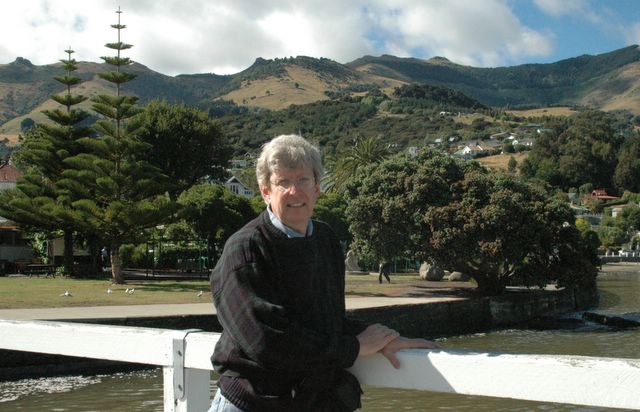
These photos of our February 2005 vacation to South Island, New Zealand run in reverse order, the last picture is on top, and the first picture is on the bottom.

So long, and thanks for all the fish.

All images © 2005, David F. Traver.

You can't go to New Zealand without seeing millions of these guys. Posted by Hello

Another random rose in Akaroa Posted by Hello

A random rose in Akaroa Posted by Hello

Another beautiful small garden in Akaroa Posted by Hello

A typical yard in Akaroa Posted by Hello